


=
Employment Background Screening: A Practical Playbook for Reducing Hiring Risk and Staying Compliant
Estimated reading time: 6 minutes
Key takeaways
- Design screening by role-based risk: tier checks to match access, safety, and regulatory exposure.
- Operate efficiently and transparently: integrate with your ATS, automate status updates, and use clear candidate communications.
- Be defensible and fair: document policies, follow FCRA/state rules for adverse actions, and allow candidates to dispute findings.
- Monitor post-hire where appropriate: continuous monitoring or periodic rechecks for safety- or compliance-sensitive roles.
Table of contents
- Why employment background screening matters for HR and hiring managers
- Design a risk-based screening policy
- Example screening tiers (illustrative)
- Background checks and pre-employment verification best practices
- Common checklist of checks by role
- Operationalizing screening: workflows, integrations, and KPIs
- KPIs to monitor
- Handling adverse findings fairly and defensibly
- Continuous monitoring and post-hire checks
- Practical takeaways for employers
- Conclusion
- FAQ
Why employment background screening matters for HR and hiring managers
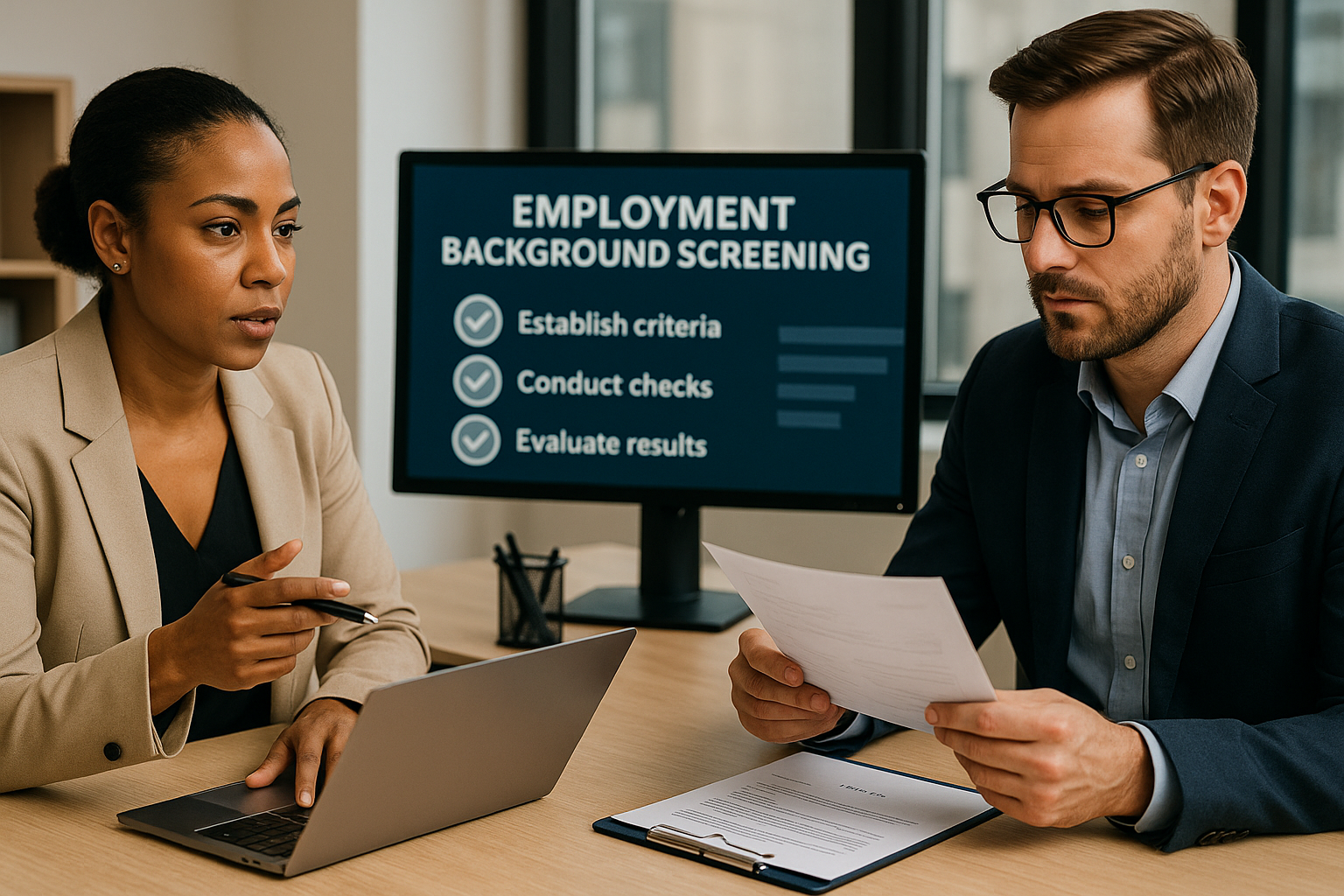
Background screening is not just a checkbox — it is part of an overall risk management strategy. When designed and executed properly, a screening program:
- Reduces negligent-hiring exposure by verifying credentials and undisclosed adverse history
- Protects customers and coworkers in safety-sensitive roles
- Helps ensure regulatory and contract compliance for regulated industries
- Improves hiring outcomes by validating candidate fit and reducing turnover from misrepresented experience
- Preserves employer brand through fair, consistent, and transparent practices
Objective: make hiring decisions predictable, defensible, and aligned to role risk — not to eliminate all risk, which is impossible.
Design a risk-based screening policy
Start with a written screening policy that ties screening depth to role-based risk. A documented policy reduces inconsistency and supports defensible adverse-action decisions.
Key components of a risk-based policy
- Role classification: Define tiers (low, medium, high risk) based on access to assets, finance duties, safety impact, or regulated activities.
- Screening matrix: Map which checks apply to each tier.
- Disqualifying criteria and weighting: List behaviors or findings that could disqualify a candidate and specify how they’re weighed.
- Consistency rules: Apply the same standards across comparable roles and locations.
- Legal review: Have counsel validate the policy for FCRA compliance and state/local restrictions.
- Documentation and retention: Define how screening records, candidate disclosures, and adverse-action letters will be stored and how long they’ll be retained.
Example screening tiers (illustrative)
- Low-risk (entry-level retail): Identity verification, SSN trace, basic criminal database search
- Medium-risk (supervisory roles): Employment and education verification, county criminal searches, reference checks
- High-risk (finance, healthcare, CDL drivers): Full national criminal search, motor vehicle record (MVR) checks, professional license verification, drug testing, continuous monitoring where appropriate
Background checks and pre-employment verification best practices
A structured approach to the actual checks ensures you gather relevant information efficiently and lawfully. Practical best practices include:
- Get clear written consent: Obtain signed candidate consent forms and a disclosure that complies with federal guidance and local requirements before ordering consumer reports.
- Use purpose-limited searches: Run only searches necessary for the role to limit privacy exposure and reduce noise.
- Prioritize verifications that demonstrate candidate qualifications: Employment history, education, professional licenses, and certifications are often highest-impact.
- Balance criminal-history screening: Use conviction-only policies where possible and evaluate nature, recency, and relation to duties.
- Verify motor vehicle records: For driving roles and insurance-sensitive positions.
- Include international checks: Candidates with overseas experience require specialized vendors and timelines.
- Protect candidate data: Secure transfer and storage, limited access, and retention aligned to policy.
- Communicate transparently: Tell candidates what you’ll check, expected timelines, and how you’ll handle adverse findings.
Common checklist of checks by role (examples)
- Identity and SSN trace
- County, state, and national criminal searches
- Employment verification (past titles and dates)
- Education and credential verification
- Motor vehicle record (MVR)
- Credit report (where legally permitted and job-relevant)
- Drug screening
- Professional license verification
- International background checks
- Reference checks
Operationalizing screening: workflows, integrations, and KPIs
A great policy fails at scale without efficient operations. Make screening part of your recruiting workflow so offers aren’t held up and candidates stay engaged.
Operational recommendations
- Integrate with your ATS: Pre-fill candidate data, trigger orders at the correct stage (post-offer or pre-offer as policy allows), and push results back to the ATS to reduce manual tasks.
- Standardize candidate communications: Use templates for consent requests, status updates, and adverse-action notifications to maintain clarity and reduce candidate withdrawals.
- Automate status tracking: Dashboards that show orders in progress, turnarounds, and exceptions help hiring teams make better decisions.
- Establish SLAs with vendors: Define expected turnaround times and escalation paths for stalled verifications.
- Train hiring teams: Recruiters and hiring managers should understand screening timelines, what different results mean, and how to engage compliance or HR for adjudication.
KPIs to monitor
- Average turnaround time by check type
- Percentage of candidates with verified employment/education
- Adverse-action rate (and breakdown by reason)
- Time from offer to hire (and how much screening adds)
- Candidate withdrawal rate during screening
- Cost per screening and cost per hire attributable to screening
- False-positive/false-negative rates from vendor audits
Improving speed without sacrificing quality:
- Order verifications concurrent with reference checks where lawful
- Use electronic consent and mobile-friendly forms
- Prioritize checks that typically take longer (international verifications, education) early in the process
- Batch orders for campus hires or volume roles
Handling adverse findings fairly and defensibly
Adverse findings are inevitable. Your process should be consistent, well-documented, and give candidates the chance to correct errors.
- Review the report for accuracy and relevance to the role.
- Send pre-adverse notice with a copy of the report and a summary of rights (per federal guidance and state law where applicable) if adverse action is contemplated.
- Allow time to dispute: Give the candidate an opportunity to explain or correct the information.
- Investigate disputes promptly: Document rationale for final decisions.
- Send final adverse-action notice if you decline employment, explaining the decision and providing compliance notifications.
Context matters: a conviction from 15 years ago may not carry the same relevance as a recent offense. Document mitigating factors you considered.
Continuous monitoring and post-hire checks
Risk doesn’t end at hire. For certain roles, continuous monitoring and periodic rechecks are effective ways to manage ongoing risk.
When to use ongoing screening
- Roles with high regulatory exposure (healthcare, finance)
- Positions that require driving or operation of heavy equipment
- Access to sensitive data, systems, or high-value assets
Types of post-hire monitoring
- Continuous criminal and sanctions monitoring services
- Periodic re-verification of professional licenses or certifications
- Random or scheduled drug testing where policy permits
- Annual attestations of continued fitness for sensitive duties
Ensure post-hire checks are covered in employment agreements and privacy notices, and comply with applicable laws.
Practical takeaways for employers
- Create a written, role-based screening policy that tiers checks by risk and is vetted by legal counsel.
- Use a consistent screening matrix and decision rules to ensure fairness and defensibility.
- Integrate screening into your ATS to speed processing and reduce manual work.
- Prioritize verification types that directly affect job performance (licenses, employment history, MVR).
- Communicate clearly with candidates at every step to preserve candidate experience and reduce withdrawals.
- Track KPIs (turnaround time, adverse-action rate, candidate withdrawal) and adjust workflows based on data.
- Implement secure data handling and retention practices to protect candidate privacy.
- Consider continuous monitoring for safety-sensitive or compliance-driven roles.
Conclusion
Employment background screening is a strategic control that protects people, assets, and reputation — when it is structured, role-focused, and operationalized. A defensible program balances thorough verification with candidate experience and speed, supported by clear policies, reliable vendors, and measurable KPIs.
If you need help: Rapid Hire Solutions offers consultative support and scalable screening services to design a risk-based program, integrate screening into your ATS, or audit your policy. Reach out to discuss a pilot or compliance review tailored to your hiring risk profile.
FAQ
Best practice is to run checks at the stage your policy permits (commonly post-offer, pre-employment) to reduce candidate drop-off and ensure compliance with notice/consent requirements. Where lawful and defensible, some verifications (like education or employment) may be triggered earlier to speed hiring.
Review for accuracy and relevance. Follow your pre-adverse and adverse-action procedures under FCRA/state law: provide the candidate a copy of the report and summary of rights, allow time to dispute, document the analysis, and send a final notice if employment is denied.
Not for all roles. Continuous monitoring is recommended for positions with ongoing safety, regulatory, or asset exposure (e.g., healthcare, finance, drivers). Include post-hire monitoring in agreements and privacy notices and ensure legal compliance.
Track average turnaround time by check type, percentage of verified qualifications, adverse-action rate and reasons, time from offer to hire, candidate withdrawal during screening, and cost per screening. Auditing vendor accuracy helps surface false positives/negatives.
Use clear, mobile-friendly consent forms, set expectations for timelines, send standardized status updates, and minimize invasive searches to only those necessary for the role. Fast turnarounds and transparent communication reduce withdrawals and preserve employer brand.